
Fears World War 3 could start today as Trump hints at using nuclear weapon to wipe out Iran


Fears over a dramatic escalation of tensions that could herald the start of World War III are widespread after Donald Trump warned that Iran could be wiped out “in one night” in a startling recent speech.

Concerns over Trump’s increasingly unpredictable, oft nonsensical rhetoric hit new heights yesterday when the POTUS appeared to flirt with the idea of nuclear war.

The US and Israel have been in conflict with Iran since the two countries launched joint strikes on February 28. In the opening salvos of the war, Supreme Leader Ali Khamenei was killed, along with multiple family members.

The Trump administration has repeatedly claimed that Iran pose no military threat in the weeks following, and that the Middle Eastern country have effectively been beaten into complete submission.

Iran, however, continue to deny that they are negotiating with Trump over a peace deal, and have launched a series of retaliatory attack. They also maintain de facto control over the important Strait of Hormuz, a critical global energy route through which an estimated 20% of the world’s oil supply passes.

With an end to the conflict not nearly in sight, it appears Trump has grown increasingly frustrated with what he believed would be a relatively simple and swift undertaking.


WASHINGTON, DC – APRIL 1: President Donald Trump pauses as he finishes speaking about the Iran war from the Cross Hall of the White House on Wednesday, April 1, 2026, in Washington. Trump used the prime-time address to update the nation on the war in Iran. (Photo by Alex Brandon-Pool/Getty Images)

At a speech at the White House yesterday (Monday, April 6), Trump threatened Iran by saying the entire country “could be taken out in one night.” He ominously added: “And that night could be tomorrow night.”

The warning comes prior to a deadline set by Trump for Tehran to reopen the aforementioned Strait of Hormuz.

The 79-year-old demanded an ‘acceptable’ deal by 20:00 Washington DC time today (Tuesday, April 7). According to the BBC, he threatened that should the deadline be missed, Iran could be pushed back to the ‘Stone Ages’.

“They’re going to have no bridges,” Trump said.

“They’re going to have no power plants.”

Naturally, people on social media are now speculating over the nature of Trump’s warnings, and what sort of destructive force could make his threats credible.

Some stated their belief that Trump might be indirectly revealing his intent to unleash nuclear weapons.

“The only way to take a country out in one night is with nukes. Remove this lunatic now before he burns the whole world down & starts a nuclear war,” one person wrote on X.
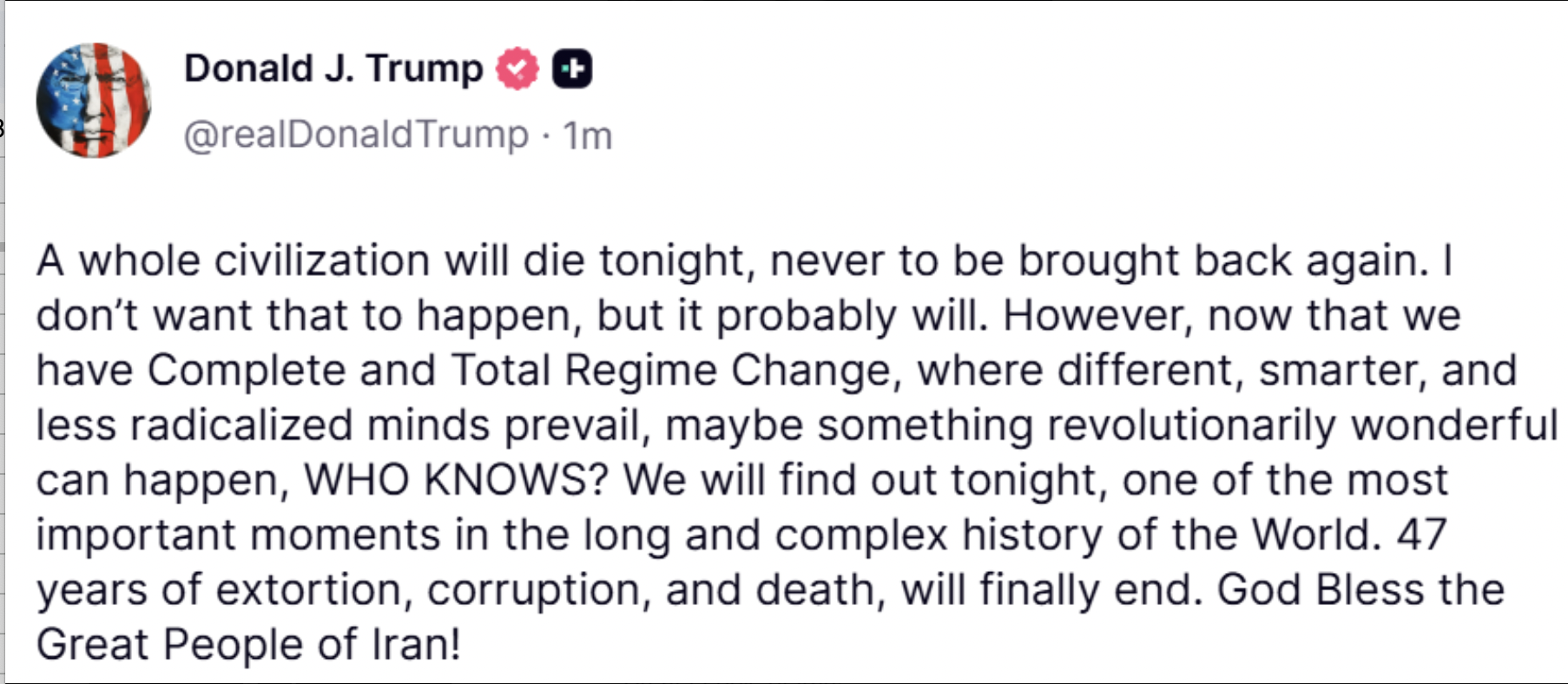

Credit / X


In perhaps his most terrifying post yet, Trump wrote today that “a whole civilization will die tonight, never to be brought back again. I don’t want that to happen, but it probably will.”

What do you make of Trump’s words? Let us know in the comments.

Comments

Popular posts from this blog

7 Things That Happen To Your Body When You Don’t Have Sex For A While

 We all know that sex is good for you. It is a natural human act that, when done carefully and consensually, can be pleasurable and improve your health. But do you know why? How does it affect your body? And most importantly: What happens when you don’t have sex for a while? Here are some of the most common side effects of not getting enough action. Things That Happen To Your Body When You Don’t Have Sex For A While Sex, though often still a very taboo subject, is an important part of health. It is a way to express yourself, deepen your connection with another person, and make you feel happy and energized. Sometimes, however, we go through periods of life where we are either focused on other things, or we have simply decided to take a break from the act. Have you ever wondered what happens to your body when you haven’t had sex for a while? These are some of the things you might experience. Increased stress Sex helps relieve stress and lowers cortisol levels. When you’re stressed, y...

More people are coming out as Aegosexual – here’s what it means

  As discussions around sexuality become more layered, so does the vocabulary used to describe them. One term now drawing attention is aegosexual, an “identity-less” experience that’s defined by “disconnection.” With gender and sexuality now part of everyday conversation, it’s no surprise that a growing number of new labels are finding their way into the mainstream. Aegosexuality, part of the asexual spectrum, describes people who experience arousal or desire without wanting to engage in sexual activity. At its core, the identity centers on a disconnect between experiencing attraction and wanting to personally act on it. ‘Disconnection’ The concept was first introduced in 2012 by Canadian psychologist and sexologist Anthony Bogaert, who originally referred to it as “autochorissexualism.” Bogaert described the experience as an “identity-less sexuality,” that’s “characterized by a disconnection between their sense of self and a sexual object or target.” In practical terms, someone wh...

Common back-pain drug may be linked to higher dementia risk, large study finds

  A pain medication that millions of Americans rely on for chronic back pain may come with a hidden risk: a significantly higher chance of developing dementia or other cognitive problems, according to a major new study. Compared 26,000 adults Researchers from Case Western Reserve University and several partner institutions analyzed medical records from 68 health systems across the U.S., comparing 26,414 adults prescribed gabapentin for persistent low-back pain with a matched group who had similar pain — but didn’t take the drug. Their finding was sobering: Adults who received six or more gabapentin prescriptions were 29% more likely to be diagnosed with dementia and 85% more likely to develop mild cognitive impairment (MCI) within 10 years. The risk wasn’t limited to older adults. In fact, it was younger Americans who saw the most dramatic increases. Younger adults saw shocking risk increases For people normally considered decades away from dementia: Ages 35–49 taking gabapentin ha...